Scranton Quality Roofing provides commercial roofing in Scranton, PA, serving surrounding cities including Dunmore, Moosic, Old Forge, Throop and Dickson City. For more than 20 years we have repaired and replaced flat and low-slope roofs on storefronts, offices, warehouses, churches and mixed-use buildings with apartments above street-level shops.
Commercial roofs fail differently from house roofs. Water ponds instead of running off, rooftop equipment adds penetrations and foot traffic, and a leak can travel a long way under the membrane before it shows inside. We trace every commercial leak to its real source, probe for wet insulation and tell the owner plainly whether a repair, a recover or a full replacement makes the most sense.
Every commercial proposal we write lists the work as separate lines: tear-off, insulation, membrane, flashing, edge metal and drainage. That makes it easy for an owner, a property manager or a board to compare bids and understand exactly what each one includes.
Commercial Roofing Systems
Modified Bitumen: Torch-Down SBS and APP
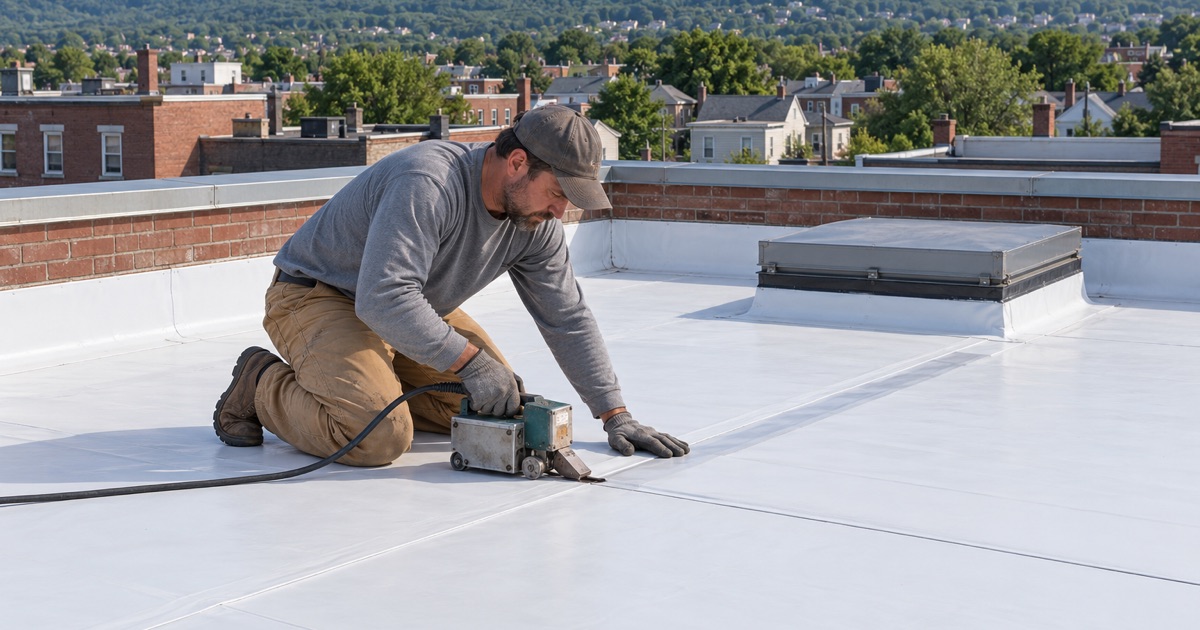
Modified bitumen is asphalt reinforced with polymers and applied in layers, either torched, cold-applied or self-adhered. SBS membranes stay flexible in cold weather, while APP membranes resist heat and ultraviolet light well. The multi-layer build makes modified bitumen tough under foot traffic, which suits roofs that see regular service visits to rooftop equipment.
Torch-applied roofing requires careful fire safety, especially near wood framing, parapets and rooftop equipment. Where an open flame is a concern, we use cold-applied or self-adhered modified bitumen instead.
EPDM Rubber Membranes
EPDM is a synthetic rubber membrane installed in large sheets with few seams. It handles temperature swings well and has a long track record on low-slope roofs. Seams are joined with tape or adhesive, and the membrane can be fully adhered, mechanically fastened or ballasted depending on the building.
EPDM is often the most economical membrane for a simple, open roof. On roofs crowded with equipment and penetrations, the extra seams and flashings need careful detailing.
TPO and PVC Single-Ply Membranes
TPO and PVC are thermoplastic membranes with heat-welded seams that become a single continuous sheet. Their white surfaces reflect sunlight and can lower cooling costs in summer. PVC also resists grease and chemicals, which makes it a good choice around restaurant exhaust fans. Welded seams are stronger than taped or glued ones when installed correctly, and we test every seam with a probe after welding.
Commercial Roof Repair and Maintenance
Seams, Blisters and Punctures
Most commercial leaks start at a seam that has opened, a blister that has cracked or a puncture from dropped tools or equipment. We repair each with materials compatible with the existing membrane, because mismatched patches tend to fail quickly.
After repairing the leak we walk the rest of the roof and note any other weak spots in writing, so the owner can address them before the next storm finds them.
Flashing at Parapets, Curbs and Edges
Parapet walls, HVAC curbs, exhaust fans and roof edges are where membranes most often fail. We rebuild base and counter flashing at walls, re-flash equipment curbs and replace worn edge metal so wind cannot peel the membrane back from the perimeter. Pitch pockets around odd-shaped penetrations dry out and crack over time, and we refill or replace them as part of regular maintenance.
Drains, Scuppers and Ponding Water
A flat roof only works if water leaves it. We clear clogged drains, reset drains that have pulled away from the membrane and resize scuppers that cannot keep up. Persistent ponding adds weight and stresses every seam, so we look at tapered insulation or added drains when water sits for days after a storm.
Regular Inspections for Building Owners
Routine inspections catch small problems before they become interior damage. We inspect commercial roofs on a schedule, clear debris from drains and keep written records with photos, so owners can see how the roof is aging and plan repairs and replacement in their budgets.
Commercial Roof Replacement
Tear-Off, Recover and Wet Insulation
When a commercial roof reaches the end of its life, the first question is whether to tear off or recover. If the existing roof is dry and sound, a new membrane can sometimes go over it. If the insulation is wet, it has to come out, because trapped moisture rots the deck and shortens the life of the new roof. We test the existing roof before recommending either approach and explain the cost difference in the written proposal.
Insulation and Tapered Systems
A replacement is the best time to add insulation and correct drainage. Tapered insulation creates slope toward drains on a flat deck, so water no longer ponds. Added insulation also reduces heating costs through a long Northeastern Pennsylvania winter.
Snow Load and Older Commercial Buildings
Scranton averages about 45.1 inches of snow a year, and drifts collect behind parapets, rooftop units and higher walls. Older commercial buildings were designed to different standards, so before adding weight such as extra insulation layers or new equipment, we look for signs of deflection and recommend an engineer’s review when there is any doubt.
Working Around Your Business
Scheduling and Access
We plan commercial roofing work around business hours where possible, stage materials to keep entrances clear and protect sidewalks and parking areas. Each section of roof is dried in before the end of the day, so a passing storm cannot reach the interior. For mixed-use buildings, we coordinate with both the businesses below and the residents above so everyone knows when work is happening and how to reach us.
Safety on the Roof and Below
OSHA fall protection rules apply to every roofing crew, and we set up guardrails, warning lines or personal fall arrest as the roof requires. On the ground, we keep debris chutes, dumpsters and work zones fenced off from customers and the public.
Permits and Paperwork
Scranton requires a permit for all construction work, and permit applications from licensed contractors must include a complete executed copy of the contract. Neighboring boroughs and townships each set their own rules. We confirm the requirements for your building’s municipality before pricing, so the permit is part of the proposal from the start.
- 20+ Years Roofing
- Free Written Estimates
- Repair Before Replace